
Journal
Best Deck Boxes for Trading Cards: 2026 Buyer's Guide
Discover the best deck boxes for trading cards in 2026. Compare materials, card capacity, and protection features to find the right fit.
Table of Contents
- What Actually Matters in a Deck Box
- Magnetic vs Flip Deck Boxes: Which Closure Holds Up?
- Protection and Durability: What Survives Real Use
- How to Store Trading Cards So They Stay Mint
- Best Card Sleeves for Trading Cards: The Other Half of Protection
- Matching the Box to Your Format: Commander, Standard, and Beyond
- Budget, Premium, and Custom Options
- Frequently Asked Questions
Last Updated: September 16, 2026
What Actually Matters in a Deck Box
A deck box is the rigid container that holds a sleeved trading card deck, and the details that separate a good one from a bad one are capacity, fitment, and closure quality. This guide from Noble Nerds breaks down what actually protects your cards, based on how these boxes hold up in real use rather than marketing copy.
Most players shop by color and price. That's backwards. The three specs that decide whether a deck box survives a year of weekly play are internal dimensions, wall rigidity, and how the lid locks. Get those wrong and you'll be rebuying in six months.
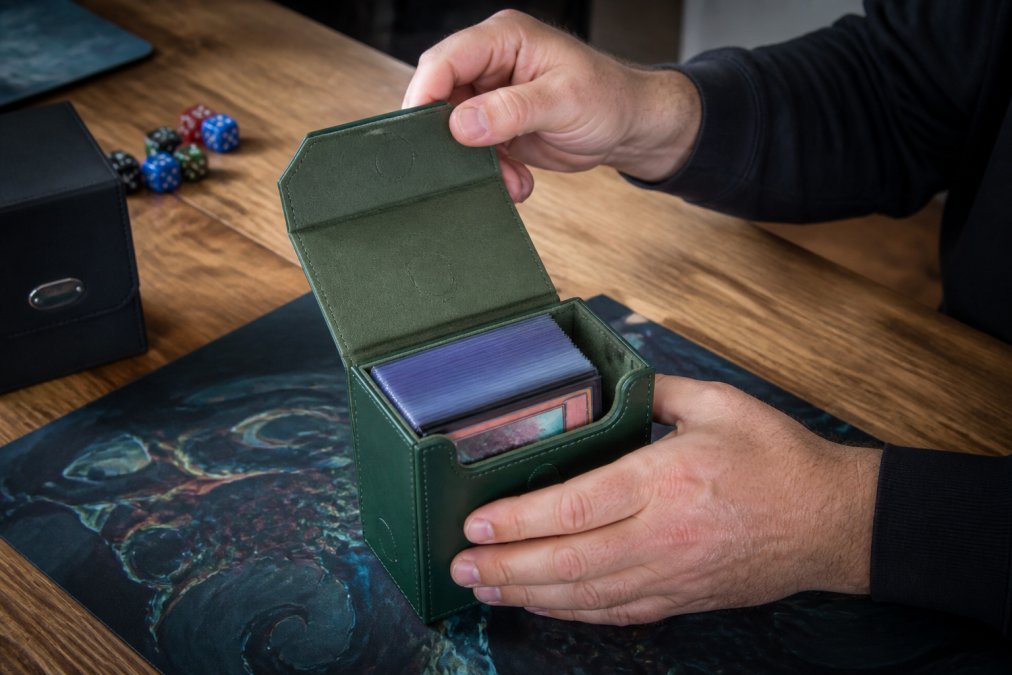
Capacity, Fitment, and Double-Sleeved Cards
Double-sleeved cards are cards placed in an inner sleeve and then an outer sleeve, which adds roughly 1-2 mm of thickness per card. A 100-card Commander deck that fits loosely in a single-sleeved box will not fit the same box once double-sleeved.
This is the single most common mistake buyers make. A box rated for 100 cards usually means 100 single-sleeved cards. If you double-sleeve, you need a box rated for 120 or more, or one with a convertible design that expands. Measure your sleeved stack before you buy: a 100-card double-sleeved Commander deck typically runs 7-8 cm thick.
Materials: Rigid Construction vs. Soft Cases
Rigid construction means the box holds its shape under pressure, which is what actually prevents bent corners. Soft cases and fabric deck bags offer almost no impact protection; they protect against scratches and dust, not a drop onto concrete.
The materials worth knowing:
- Xenoskin: a textured synthetic leather with a soft microfiber lining; good scratch resistance, mid-weight
- Leatherette: similar feel, usually cheaper, wears faster at the hinge
- Plastic: the most rigid and cheapest, but hinges crack and it offers no cushioning
- Wood or acrylic: heavy-duty, excellent rigidity, poor portability
For a deck that leaves the house, rigid walls plus a soft interior lining is the combination that lasts.
Magnetic vs Flip Deck Boxes: Which Closure Holds Up?
Magnetic closure boxes use embedded magnets to snap the lid shut; flip boxes use a hinged lid with friction or a latch. For most players, magnetic closures win on convenience and secure locking, while flip boxes win on price.
Here's where it gets interesting: the failure mode is different for each. Magnets lose holding force if the lid warps, and cheap magnets are glued in and pop out. Flip hinges crack at the fold, usually within a year of daily opening. If you open your box several times per session, a magnetic closure with a recessed magnet channel outlasts a friction hinge. If the box mostly sits on a shelf, a flip lid is fine and costs less.
Protection and Durability: What Survives Real Use
The features that matter for card protection are a snug fit, a soft interior, and a lid that doesn't shift. A box that lets cards slide around causes edge wear even when nothing hits it.
Look for:
- Microfiber lining to prevent surface scuffing
- A divider or deck block so cards don't rattle
- A recessed lid lip that seats without pinching the top card
- Rigid construction on all six faces, not just the lid
Long-Term Durability: What Wears Out First
In practice, three things fail first: the hinge, the magnet retention, and the interior lining at the corners. Hinges crack from repeated stress. Glued magnets work loose. Lining peels where cards rub against the same spot every time you insert the deck.
A common mistake is judging a box by how it feels new. Squeeze the walls, flex the lid, and check whether the magnets are seated in a channel rather than surface-glued. Those three checks predict most long-term failures better than any spec sheet.
How to Store Trading Cards So They Stay Mint
Storing trading cards so they stay mint means controlling three things: physical pressure, moisture, and light. Sleeves handle surface protection; the box handles pressure and light; storage location handles moisture.
The layered approach most collectors use:
- Sleeve each card (inner sleeve for high-value cards)
- Load into a rigid deck box with a divider
- Store the box upright, not stacked under weight
- Keep boxes out of direct sunlight and away from damp basements or hot cars
Heat is the underrated threat. Cards left in a hot car can warp, and no deck box prevents that. The box protects against handling and drops; your storage location protects against temperature and humidity.
Best Card Sleeves for Trading Cards: The Other Half of Protection
The best card sleeves for trading cards are the ones that fit your box. Sleeve choice and box choice are one decision, not two, because sleeve thickness determines whether your deck fits at all.
Standard-size sleeves fit most trading card games, while Japanese-size sleeves fit the smaller card format.
Matching the Box to Your Format: Commander, Standard, and Beyond
Format determines capacity. A Commander deck runs 100 cards plus tokens and often a sideboard, so it needs a 100+ or 120+ box. A Standard 60-card deck fits a compact box with room for a dice tray or accessory compartment.
| Format | Cards | Recommended Box Capacity | Notes |
|---|---|---|---|
| Commander / EDH | 100 + tokens | 120+ | Needs room for double sleeves and tokens |
| Standard | 60 + sideboard | 80-100 | Compact design works well |
| Limited / Draft | 40 + lands | 75+ | Accessory compartment for dice |
| Multi-deck carry | 2-4 decks | Modular storage case | Look for removable deck blocks |
Budget, Premium, and Custom Options
Price tiers in deck boxes track three things almost perfectly: wall rigidity, interior lining, and closure hardware. Everything else is color and branding.
What Each Tier Actually Buys You
Budget (roughly $5-$15): molded plastic or thin leatherette, a friction-fit or single-magnet lid, and no interior lining. These boxes hold cards and keep dust off. They are fine for a deck that lives on a shelf and gets opened once a week. Expect the hinge or the lid latch to be the first failure point.
The Three Parts That Decide Whether You Rebuy
Where budget boxes fall short is exactly where premium boxes earn their price:
- The hinge: friction hinges and thin plastic living hinges crack at the fold, often within a year of daily opening. A metal pin hinge or a magnetic lid avoids the failure entirely.
- The magnet retention: cheap magnets are surface-glued and pop out. Look for magnets seated in a molded channel or recess, which is a visible difference you can check before buying.
- The lining: unlined boxes let cards rub against bare plastic or wood, scuffing edges over time. A microfiber lining at the corners, where cards rub the same spot on every insert, is the single cheapest upgrade that extends card life.
Customization and DIY Modifications
A few low-cost upgrades can make a mid-range box behave like a premium one:
- Add dividers: thin plastic or foam board cut to the box's internal width keeps a partial deck from sliding and separates tokens from the main deck.
- Label the box: a strip of painter's tape or a label maker tag on the spine lets you find a deck on a shelf without opening five boxes.
- Replace the lining: self-adhesive felt or microfiber sheet cut to size refreshes a worn interior for a few dollars.
- Re-seat loose magnets: a drop of two-part epoxy holds a popped magnet better than the original glue, though this voids most warranties.
What to Check Before You Buy
Squeeze the walls, flex the lid, and check whether the magnets sit in a channel or are surface-glued. Those three checks predict most long-term failures better than any spec sheet. If you play weekly, a mid-range box with a lined interior and recessed magnets usually costs less over two years than replacing budget boxes.
Frequently Asked Questions
What features should I look for in a trading card deck box?
Prioritize rigid construction, a secure closure, and capacity that fits your double-sleeved cards. A microfiber lining helps prevent scratches, while a divider and accessory compartment keep dice and tokens separate. Check the deck box dimensions against your sleeve thickness before buying. If you play Commander, look for a box rated for 100+ double-sleeved cards with room for tokens.
Are hard plastic deck boxes better than soft cases?
Hard plastic and rigid deck boxes offer better impact protection and keep cards from bending during transport. Soft cases are lighter and cheaper but can crush under pressure in a backpack. For valuable or double-sleeved decks, a rigid box with a magnetic closure is the safer long-term choice. Soft cases work fine for casual storage at home, but they are not ideal for travel.
How many cards can a standard deck box hold?
Most standard deck boxes hold 100+ single-sleeved cards or roughly 75 to 80 double-sleeved cards. Commander decks usually need a box rated for 100+ double-sleeved cards to fit comfortably with tokens. Always check the listed card capacity and whether it accounts for sleeve thickness. A box that fits 100 unsleeved cards may only fit 60 to 70 once double-sleeved.
Are magnetic deck boxes safe for trading cards?
Yes, magnetic deck boxes are safe as long as the magnets are embedded in the lid and not in direct contact with the cards. The magnetic closure keeps the box shut during transport without rubbing against card edges. Look for a box with a soft microfiber lining and a recessed magnet design. Avoid any box where loose magnets could shift and press against the cards.